
Cell
Cell is defined as the structural and functional unit of the living body. All living things are composed of cells. A single cell is the smallest unit that possesses all the characteristics of life. The general characteristics of most cells under normal conditions are:
- A cell needs nutrition and oxygen.
- It produces its own energy necessary for growth, activities, and repair.
- It eliminates carbon dioxide and other metabolic wastes.
- It maintains its internal environment for survival.
- It shows an immediate response to the entry of invaders such as bacteria or toxic substances into the body.
- It reproduces by division. There are some exceptions, such as neurons, which do not normally reproduce.
Structure of the Cell
Each cell consists of a cell body enclosed by a membrane. The covering is called the cell membrane. It is also known as the plasma membrane. The cell membrane separates the cell body from the fluid surrounding the cell. The cell body has two parts, namely the nucleus and the cytoplasm surrounding the nucleus.
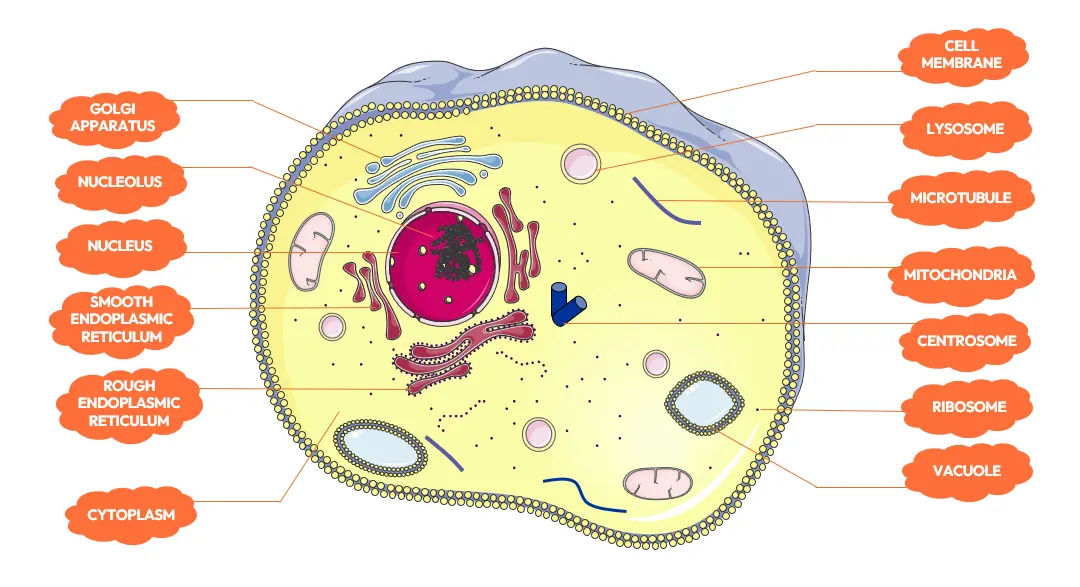
Thus, the structure of the cell can be studied under three main headings:
- Cell Membrane
- Cytoplasm
- Nucleus
Cell Membrane
The cell membrane is also known as the plasma membrane.
It is a thin, living, selectively permeable membrane that:
- Surrounds the cytoplasm.
- Separates the internal environment of the cell from the external environment.
- Maintains cell integrity and homeostasis.
Thickness: ~7–10 nm (75–100 Å)
Present In: All living cells
Chemical Composition of Cell Membrane
The cell membrane is composed of three types of substances, namely:
- Lipids
- Proteins
- Carbohydrates (Oligosaccharides)
Lipids
Lipids form the basic framework of the plasma membrane. The major lipids are phospholipids.
Structure of a Phospholipid
- Hydrophilic Head (Phosphate + Alcohol) – Faces water
- Hydrophobic Tail (Fatty Acids) – Faces the inside of the membrane
Membrane Associated Lipids
Membrane-associated lipids (MALs) are described as amphipathic because they contain both hydrophilic and hydrophobic ends. Therefore, they automatically form a lipid bilayer in water.
Types of Membrane Lipids
- Phospholipids (Major component)
- Glycolipids (Present on the outer surface)
- Cholesterol (Present mainly in animal cell membranes) – Acts as a fluidity buffer
Proteins
Proteins are responsible for most membrane functions. Through the freeze-etching technique, it has been shown that membranes have a complex internal structure. Membrane proteins are of the following types:
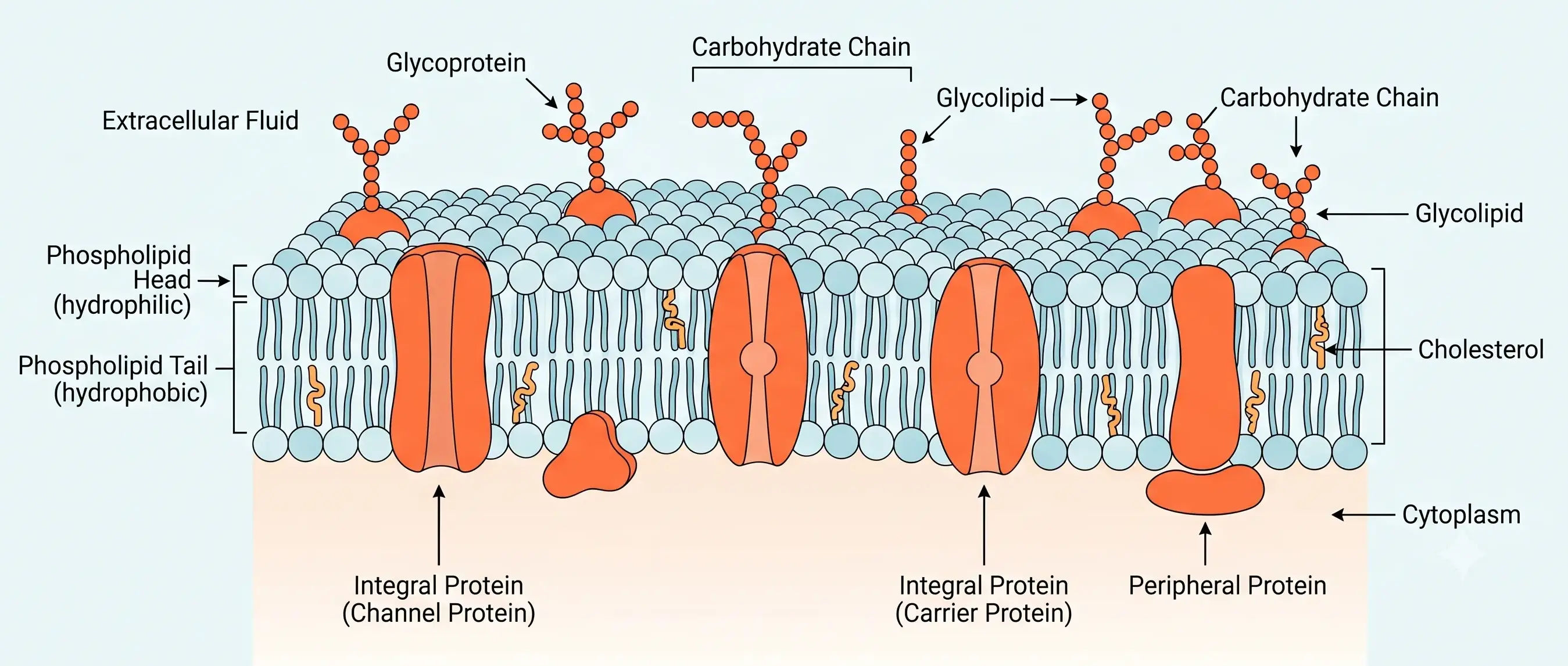
Integral (Intrinsic / Transmembrane / Transport) Proteins
- Usually globular in shape.
- Embedded within the lipid bilayer.
- Difficult to remove.
Peripheral (Extrinsic) Proteins
- Attached to the membrane surface.
- Easy to remove.
- Function as enzymes and cytoskeletal anchoring proteins.
Oligosaccharides (Carbohydrates)
- Glycolipids: Lipids with one or more carbohydrate residues attached covalently.
- Glycoproteins: Proteins with covalently attached carbohydrate chains, exposed on the outer side of the membrane.
Fluid Mosaic Model
The Fluid Mosaic Model was proposed by Singer and Nicolson (1972). According to this model, the cell membrane consists of a fluid phospholipid bilayer in which proteins are embedded and can move freely.
The plasma membrane is a quasi-fluid phospholipid bilayer in which proteins are embedded, forming a dynamic mosaic structure.
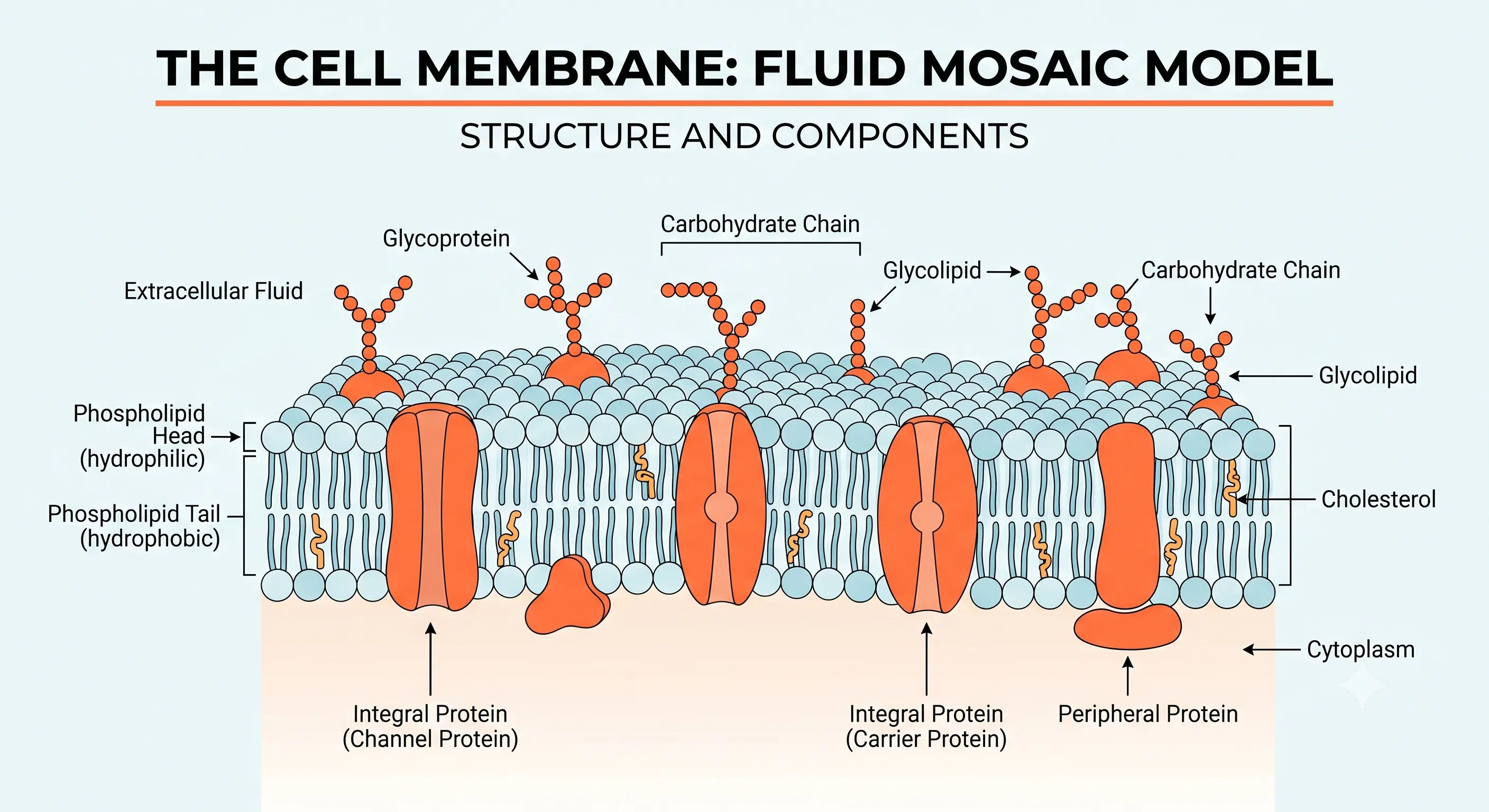
The membrane is described as:
- Fluid because phospholipids and some proteins can move laterally within the membrane.
- Mosaic because various proteins are scattered within the phospholipid bilayer, giving it a mosaic appearance.
Main Features:
- The basic structure is a phospholipid bilayer.
- Integral proteins are embedded within the lipid bilayer.
- Peripheral proteins are attached to the membrane surface.
- Carbohydrates occur as glycoproteins and glycolipids on the outer surface.
- Cholesterol helps maintain membrane fluidity and stability.
Cytoplasm
The cytoplasm is a semi-fluid matrix that occupies most of the volume of the cell. It is the main arena of cellular activity in both plants and animals. Various chemical reactions occur in it to keep the cell in a living state.
Components of Cytoplasm
- Hyaloplasm (Cytosol)
- Cell Organelles
- Double Membrane
- Mitochondria
- Plastids (present only in plant cells)
- Nucleus
- Single Membrane
- Lysosomes
- Peroxisomes
- No Membrane
- Ribosomes
- Centrioles
- Nucleolus
- Double Membrane
- Cell Inclusions
- Vacuoles
- Sap Vacuoles
- Contractile Vacuoles
- Food Vacuoles
- Storage Products
- Excretory Products
- Secretory Products
- Mineral Matter
- Vacuoles
Cytoplasmic Matrix (Hyaloplasm)
It is a transparent, homogenous and colloidal substance; it is also known as Cytosol. It is a crystallo-colloidal complex, where water is the solvent or dispersion medium.
Because of its colloidal nature, the cytoplasm can exist in two interchangeable physical states, a phenomenon known as phase reversal.
- Sol State - Thin, fluid, watery (Plasmasol or Endoplasm)
- Gel State - Thick, semi - solid, jelly like (Plasmagel or Ectoplasm)